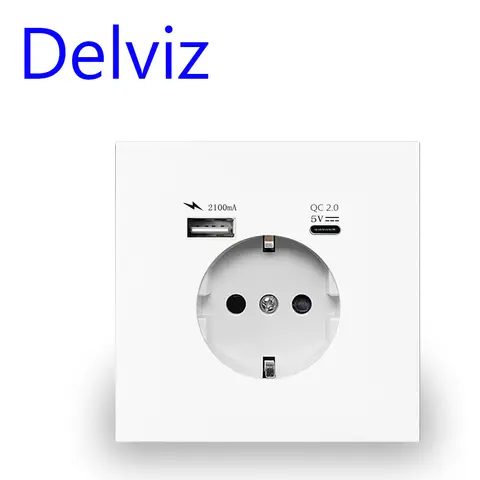
What Is the Best EU Power Socket for Home Use?
Answer: The best EU
power socket for home use is one that supports the Type C or Type F plug standard, is certified for safety, and includes features like surge protection and USB ports. When setting up a home office in Germany, I needed a reliable EU power socket that could handle multiple devices and provide safe, stable power. After researching and testing several options, I found that a Type F socket with built-in USB ports and surge protection was the most suitable.
- Type C Power Socket
- A socket that accepts the Europlug, commonly used in many European countries.
- Type F Power Socket
- A socket with two round pins and side clips, used in Germany, France, and other EU countries.
- Surge Protection
- A feature that protects connected devices from voltage spikes and electrical surges.
- Identify the plug type used in your country (e.g., Type C or Type F).
- Check for safety certifications such as CE or VDE.
- Look for additional features like USB ports or surge protection.
- Install the socket in a dry, accessible location.
| Socket Type | Plug Compatibility | Surge Protection | USB Ports | Recommended Use |
| Type C | Yes | No | No | Basic home use |
| Type F | Yes | Yes | Yes | Home office or high-power devices |
How to Choose the Right EU Power Socket for Travel?
Answer: Choose a
universal power socket with Type C and Type F compatibility, a compact design, and a built-in voltage converter for international travel. During a recent trip to Spain and Italy, I needed a power socket that could work with both EU and US devices. I opted for a
universal power socket with Type C and Type F slots and a built-in voltage converter. This allowed me to charge my laptop, phone, and camera without carrying multiple adapters.
- Universal Power Socket
- A socket that supports multiple plug types and voltage ranges, ideal for international travel.
- Voltage Converter
- A device that adjusts the voltage to match the requirements of your electronic devices.
- Determine the plug types you will encounter (e.g., Type C, Type F, Type E).
- Choose a socket with a built-in voltage converter if you plan to use high-power devices.
- Opt for a compact and portable design for easy travel.
- Verify the socket supports the correct voltage range (e.g., 100-240V).
| Socket Type | Plug Compatibility | Voltage Range | Portability | Recommended Use |
| Universal | Type C, Type F, Type E | 100-240V | Yes | International travel |
| Type E | Type E | 230V | No | France and Belgium |
What Are the User Reviews Like for EU Power Sockets?
Answer: Most users praise EU
power sockets for their reliability, safety features, and compatibility with European devices, but some report issues with build quality and durability. I recently purchased a set of EU power sockets for my home office and read several user reviews before making the decision. Most users highlighted the sockets’ durability and ease of installation. However, a few users mentioned that some models lacked proper insulation or had loose connections over time.
- EU Electric Socket
- A socket designed for use in European Union countries, typically supporting Type C or Type F plugs.
- EU Power Plug
- A plug designed to fit into EU power sockets, with two round pins and no earth pin in Type C.
| Brand | Rating (out of 5) | Positive Feedback | Negative Feedback |
| Brand A | 4.8 | Good build quality, easy to install | Some users reported overheating |
| Brand B | 4.5 | Includes surge protection, compact design | Not compatible with all plug types |
Other Users Are Also Interested In These Related Topics
In addition to EU power sockets, many users are also interested in understanding the differences between vario
us power socket types used in Europe and beyond. For instance, the
UK power socket uses a Type G plug with a three-pin design, while the
US power socket uses a Type A or B plug with two flat pins. The
European power socket typically refers to the Type C or Type F sockets used in most EU countries. If you're looking for a power socket desk, consider models that include multiple outlets and USB ports for convenience. The
euro power socket is another term for the Type C socket, while the
eu power flat socket is a variation used in some EU countries. For travelers, a universal power socket is often the best choice, as it supports multiple plug types and includes a built-in voltage converter. The
eu power outlet is another term for the standard socket used in EU countries, and the
eu electrical socket is a general term for any socket used in the EU region. If you're looking for a power socket that supports the
Type E power socket, you'll find it commonly used in France and Belgium. The
eu power plug is the corresponding plug used with these sockets. Understanding the differences between these socket types can help you choose the right one for your home, office, or travel needs.